Bedless Fajr › How to wake up for Fajr
How to wake up for Fajr
By Zakariya Telitel, independent developer of Bedless Fajr · Updated
You set three alarms. You turned off all three. You don't even remember the third one. This is not a willpower problem, and treating it like one is why it keeps happening.
Why three alarms don't work
In the first minutes after waking, your brain is not yet the brain that set the alarm. This state is called sleep inertia. Measured in the lab, cognitive performance right after waking is worse than after a full night without sleep (Wertz et al., JAMA, 2006; University of Colorado summary), and, without major sleep deprivation, it rarely lasts more than 30 minutes (Tassi & Muzet, Sleep Medicine Reviews, 2000).
So every snooze you ever pressed was pressed by a brain that could not weigh “Fajr” against “nine more minutes”. The 11 PM you signs the contract. The 5 AM you is not a lawyer. It is not even awake.
The conclusion is simple: do not ask your 5 AM brain to decide anything. Every setup that works removes the decision.
The hadith that describes it exactly
Shaytan ties three knots at the back of your head when you sleep, striking each knot with: “The night is long, so stay asleep.” If you wake and remember Allah, one knot is undone. If you make wudu, another is undone. If you pray, the last is undone, and you wake energetic and in good spirits. Otherwise you wake lazy and in bad spirits.Sahih al-Bukhari 1142, Sahih Muslim 776 (paraphrased)
Notice the order. The first knot opens with a thought, the second with water, the third with prayer. Two of the three need you on your feet: wudu and prayer. Getting vertical is the whole game. Full explanation of the three knots.
What actually works: a checklist
1. Sleep earlier, not more
Fajr in summer can be 3:40 AM. No alarm fixes a 1 AM bedtime. The Prophet ﷺ disliked talk after Isha. Put the phone in another room, or at least across the room, so the alarm forces your feet on the floor.
2. Use a real alarm, not a notification
A notification's sound is muted by the silent switch. A system alarm (AlarmKit, iOS 26) rings through it, and through Focus modes, once you allow Alarms. Which Fajr alarms ring on silent.
3. Make the alarm need your body, not your thumb
Turning off an alarm takes one thumb and zero consciousness. An alarm that won't stop until you photograph your sink, your prayer mat (unrolled), a glass of water, or your toothbrush or siwak needs you on your feet. By then, the worst three minutes are over.
4. Win the first three minutes only
Don't plan a perfect morning. Plan three minutes: feet on the floor, walk to the target, take the photo. After that, wudu and prayer are easy. Fajr is lost or won in those three minutes.
5. Track two numbers, not one
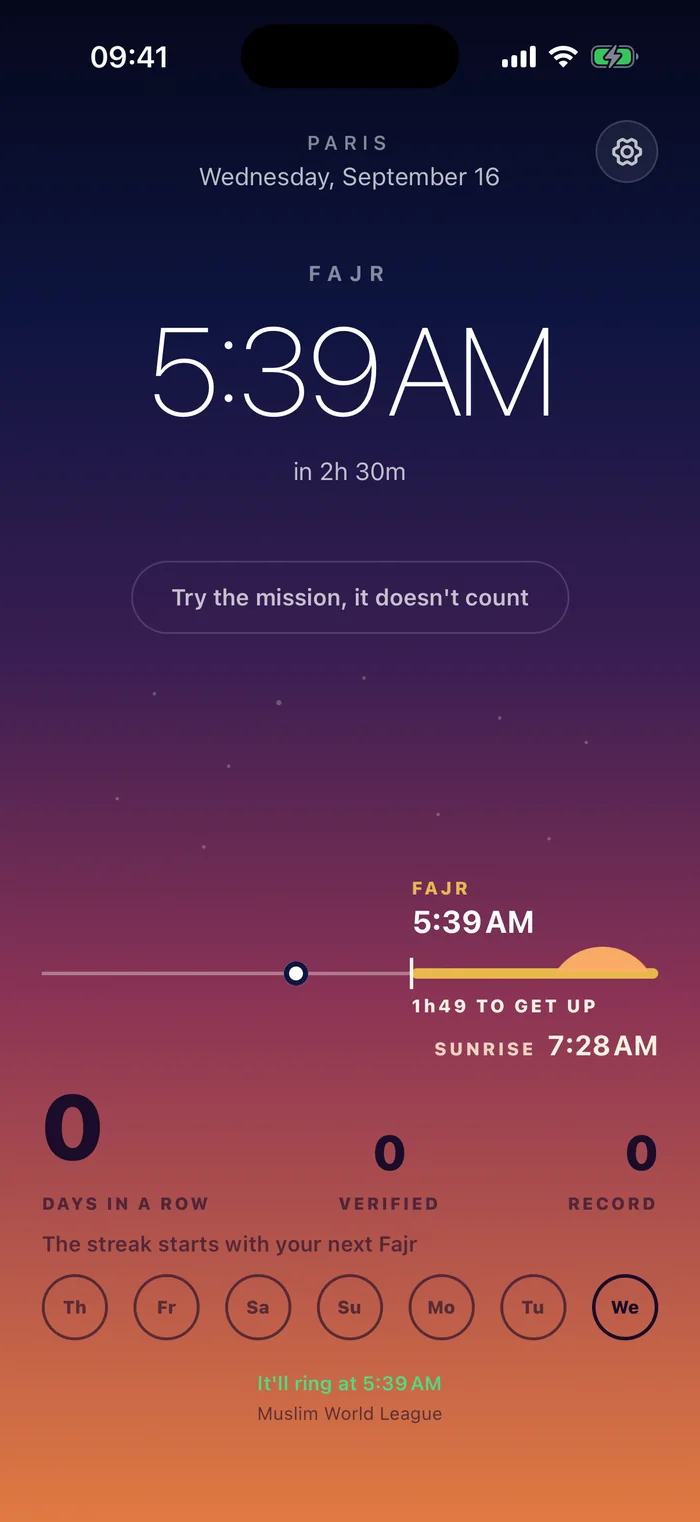
A streak you tap yourself is a streak you will lie to. Next to the days in a row, count how many of them something outside you confirmed.
6. Sisters: plan for excused days
Don't let your period break the habit. Mark those days as excused so the alarm stays off and the streak is kept, then resume with one tap.
Fajr time moves every day
Fajr is computed from the sun's angle below the horizon at your coordinates. It changes daily and differs between London, Dakar and Toronto. In June it can be before 4 AM in northern Europe; in December after 6:30. A fixed alarm at 5:30 misses Fajr half the year. Use an alarm that recomputes Fajr for your location every day, with the angle your mosque uses. Bedless Fajr does this. By default it uses an angle based on your country: ISNA 15° in the US and Canada, Umm al-Qura 18.5° in Saudi Arabia, Muslim World League 18° in the UK, France and most other countries. Change it anytime in Settings → Prayer times.
Questions
How many alarms should I set for Fajr?
One that keeps coming back. Once you allow Alarms, Bedless Fajr rings again within two minutes, for up to an hour (never after sunrise), and won't stop until a photo proves you're up.
Why do I feel terrible right after waking?
Sleep inertia. It is a measured state, worst in the first three minutes and usually gone in under 30 minutes. It is not a sign you need more sleep; it is a sign you need to get vertical and let it pass.
What time is Fajr?
It depends on your location and the calculation angle, and it changes every day. Bedless Fajr computes it for your coordinates. By default it uses an angle based on your country: ISNA 15° in the US and Canada, Umm al-Qura 18.5° in Saudi Arabia, Muslim World League 18° in the UK, France and most other countries. Change it anytime: there are nine angles, from 12° to 20°, in Settings → Prayer times.
Is there a dua for waking up for Fajr?
The Sunnah on waking is to remember Allah, for example «Alhamdulillahi alladhi ahyana ba'da ma amatana wa ilayhin-nushur». The hadith of the three knots says this remembrance is what undoes the first knot. The waking dua and its source.
An alarm built around this checklist
Bedless Fajr computes your Fajr daily, rings through silent mode once you allow Alarms, and won't stop until a photo proves you're up. Three numbers: days in a row, how many of them were verified, and your record. The record stays when the chain breaks. Every way the alarm can stop.
See how Bedless Fajr worksAlso read: Fajr alarm on silent mode · The three knots hadith